24 Unforgettable Advertisements


24 Unforgettable Advertisements

Why should ads be boring? Check out this collection of unforgettable advertisements from around the world.

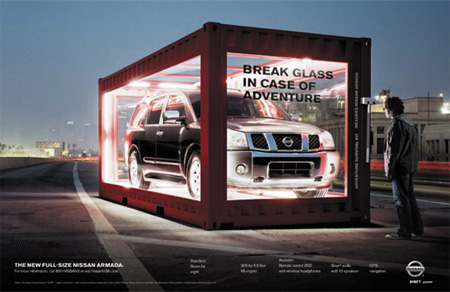
Nissan Cube Advertisement
Break Glass in Case of Adventure.
[link]

Nissan Cube Advertisement

Nike Cars Advertisement
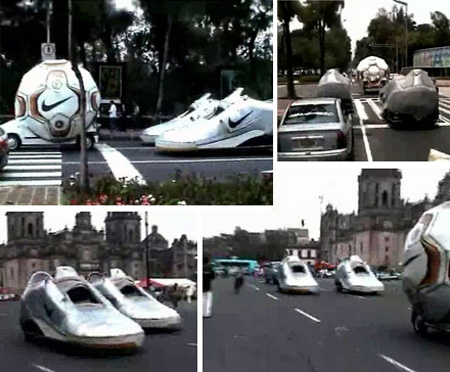
Cars decorated as Nike kicks in Mexico. The front car carrying the ball. [link]

Nike Cars Advertisement

BMW Advertisement
“From up here, I can see BMW of Bridgeport” [link]

BMW Advertisement

Nescafe Advertisement
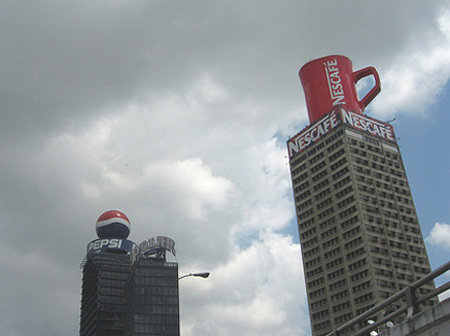
This picture of a Nescafe branded building is from Venezuela’s capital, Caracas, and must be among the largest inflatables in the world. [link]

Nescafe Advertisement

Nike Advertisement

Nike Advertisement

Nestle Advertisement
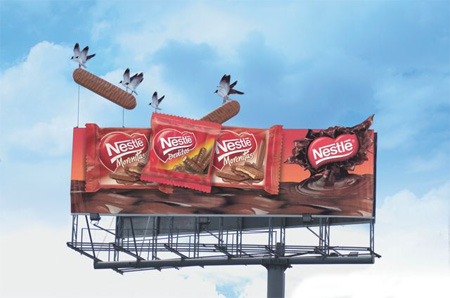
Creative Nestle billboard advertisement. [link]

Nestle Advertisement

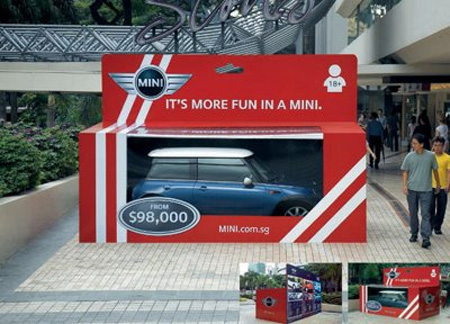
Mini Advertisement

Mini Advertisement

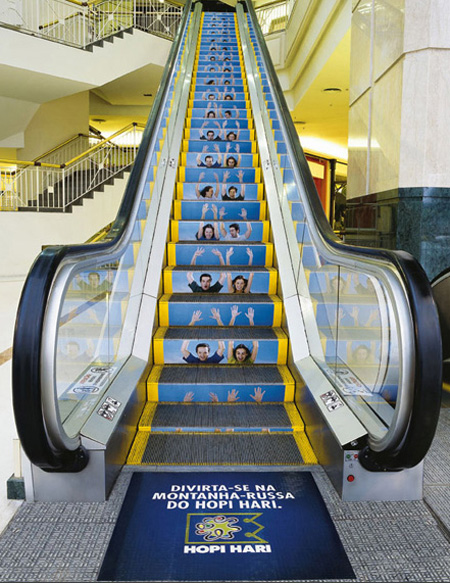
Hopi Hari Advertisement

Hopi Hari Advertisement

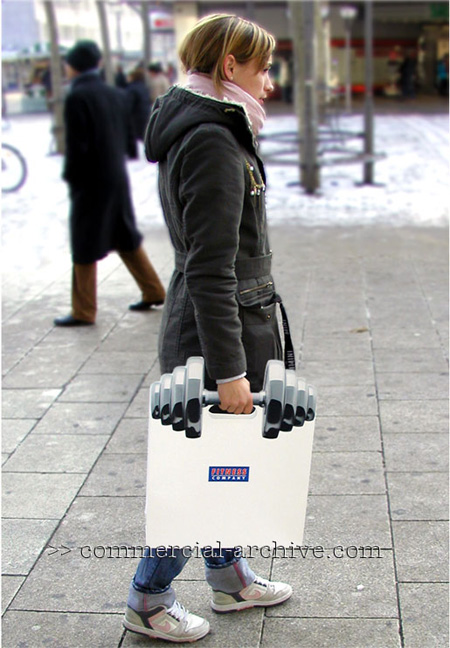
Fitness Company Advertisement
Shopping bags given away to customers when purchasing fitness accessories or nutritional supplements at the Fitness Company fitness centers. [link]

Fitness Company Advertisement

Skin Cancer Towel Advertisement
“Please take care this summer” [link]

Skin Cancer Towel Advertisement

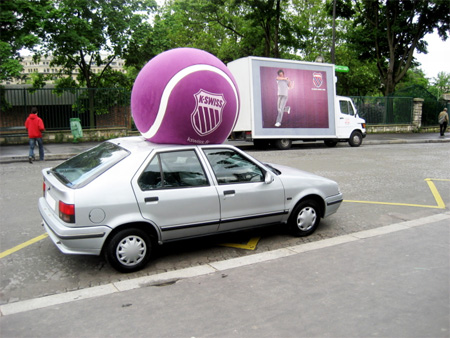
K-Swiss Advertisement

KSwiss Advertisement

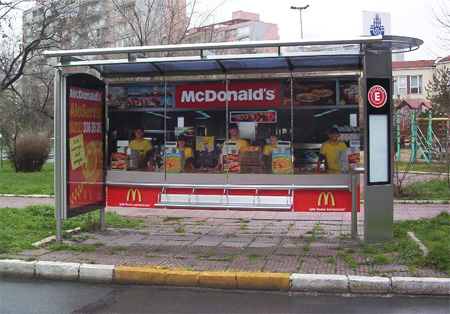
McDonald’s Bus Stop Advertisement
Just what you want while waiting for the bus: that mouth watering, tantalizing reminder of how much you’d love to stuff your face with a 1,000 calorie burger only to be reminded later by your stomach it wasn’t the best decision you could have made. [link]

McDonalds Bus Stop Advertisement

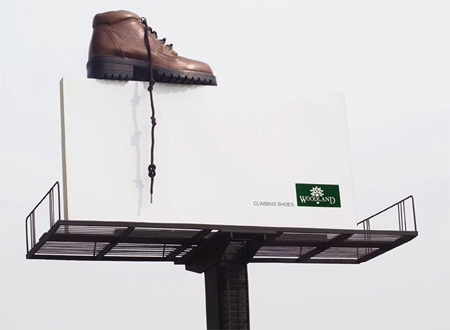
Woodland Shoes Advertisement
Powerful idea for a billboard. [link]

Woodland Shoes Advertisement

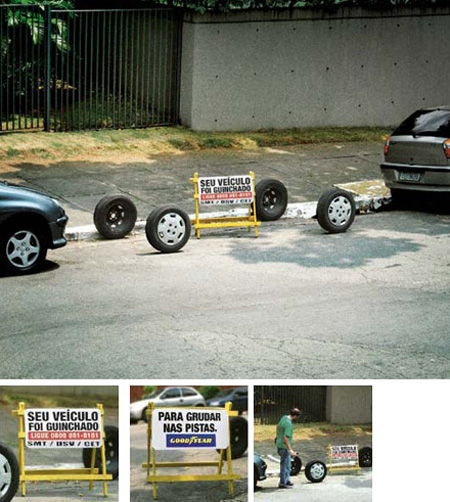
Outdoor Stunt by Goodyear
Lovely concept, but I think there’s something lost in translation in this outdoor campaign for Goodyear. The sign says: (front) “Your vehicle has been towed. Call 0800 081-8181.”
(back) “For sticking on the roads.” [link]

Outdoor Stunt by Goodyear

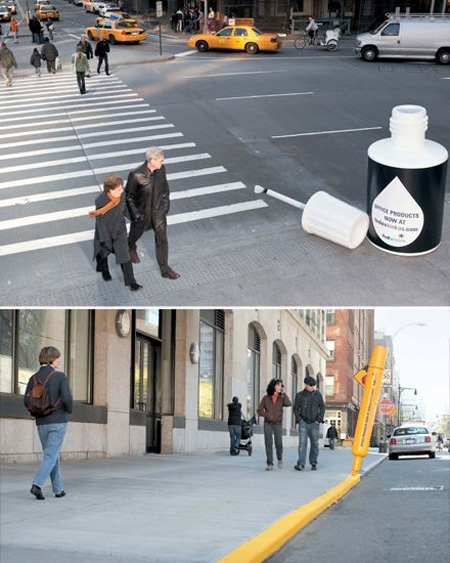
FedEx Kinko’s Advertisement
When coming up with an ad campaign for FedEx Kinko’s, the innovative minds at advertising agency BBDO were inspired by the streets of New York. The agency installed oversized bottles of correction fluid, highlighters, and, in one case, an office lamp, on the city’s busy thoroughfares for a couple of days earlier this year. [link]

FedEx Kinkos Advertisement

Peta Advertisement
The action is named ‘None of us would like to end up like this.. neither would other-than-human animals’ and it was done with four big foam trays, each of them containing a naked activist inside, and covered with a see-through plastic with a ‘Human meat’ sticker on it. The idea was to imitate the ‘meat’ trays we can find at the supermarkets and to show that we are also animals, just as other-than-human animals, we neither would like to end up there. [link]

Peta Advertisement

Ravensburger Puzzles Advertisement

Ravensburger Puzzles Advertisement

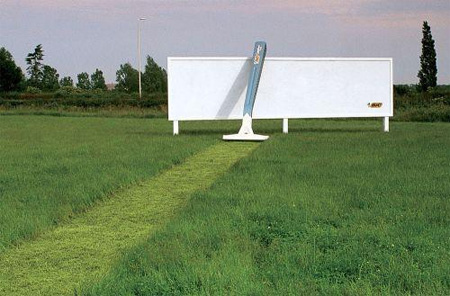
BIC Razor Advertisement
Bic developed this creative outdoor advertisement for their razors. The billboard is blank except for a small logo, but without it the advertisement might be missed and it acts as a good backdrop for the giant razor and cut grass. The only draw back is the constant trimming of the lawn. [link]

BIC Razor Advertisement

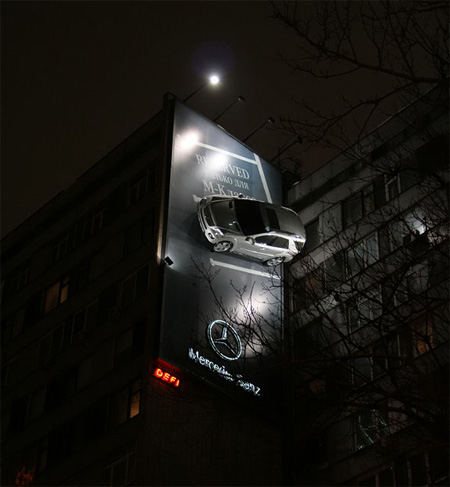
Mercedes Advertisement

Mercedes Advertisement

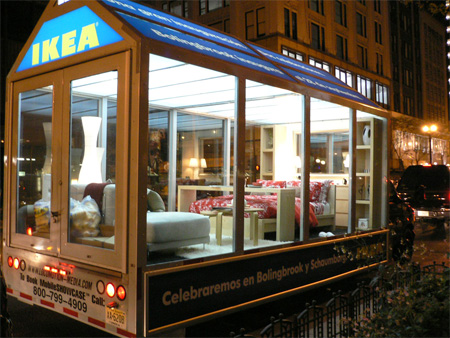
IKEA Advertisement
Ikea on Wheels advertisement. [link]

IKEA Advertisement

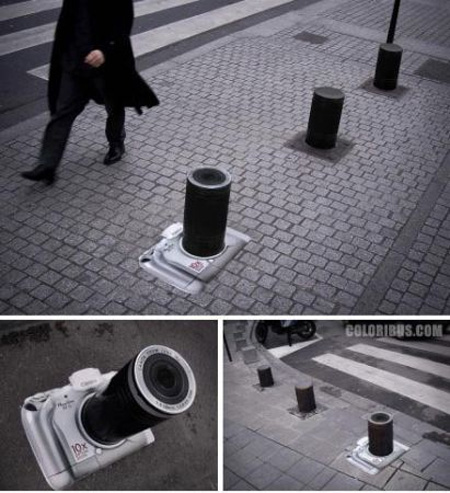
Canon Advertisement
Creative Canon outdoor advertisement. [link]

Canon Advertisement

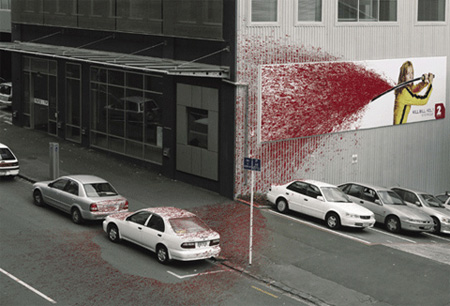
Kill Bill Advertisement

Kill Bill Advertisement

LEGO Advertisement
Lego’s ad agency in Santiago (Chile) used cranes to hang giant Lego blocks. [link]

LEGO Advertisement

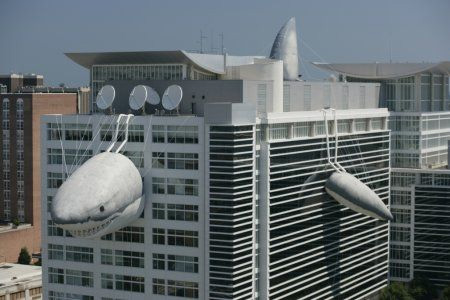
Discovery Channel Advertisement

Discovery Channel Advertisement

[via toxel.com]

Read More →

The Value of Not Overthinking a Decision


Get Out of Your Own Way

Fishing in the stream of consciousness, researchers now can detect our intentions and predict our choices before we are aware of them ourselves. The brain, they have found, appears to make up its mind 10 seconds before we become conscious of a decision -- an eternity at the speed of thought.

Their findings challenge conventional notions of choice.

[Image]
Corbis

"We think our decisions are conscious," said neuroscientist John-Dylan Haynes at the Bernstein Center for Computational Neuroscience in Berlin, who is pioneering this research. "But these data show that consciousness is just the tip of the iceberg. This doesn't rule out free will, but it does make it implausible."

Through a series of intriguing experiments, scientists in Germany, Norway and the U.S. have analyzed the distinctive cerebral activity that foreshadows our choices. They have tracked telltale waves of change through the cells that orchestrate our memory, language, reason and self-awareness.

In ways we are only beginning to understand, the synapses and neurons in the human nervous system work in concert to perceive the world around them, to learn from their perceptions, to remember important experiences, to plan ahead, and to decide and act on incomplete information. In a rudimentary way, they predetermine our choices.

To probe what happens in the brain during the moments before people sense they've reached a decision, Dr. Haynes and his colleagues devised a deceptively simple experiment, reported in April in Nature Neuroscience. They monitored the swift neural currents coursing through the brains of student volunteers as they decided, at their own pace and at random, whether to push a button with their left or right hands.

In all, they tested seven men and seven women from 21 to 30 years old. They recorded neural changes associated with thoughts using a functional magnetic resonance imaging machine and analyzed the results with an experimental pattern-recognition computer program.

While inside the brain scanner, the students watched random letters stream across a screen. Whenever they felt the urge, they pressed a button with their right hand or a button with their left hand. Then they marked down the letter that had been on the screen in the instant they had decided to press the button.

Studying the brain behavior leading up to the moment of conscious decision, the researchers identified signals that let them know when the students had decided to move 10 seconds or so before the students knew it themselves. About 70% of the time, the researchers could also predict which button the students would push.

"It's quite eerie," said Dr. Haynes.

Other researchers have pursued the act of decision deeper into the subcurrents of the brain.

In experiments with laboratory animals reported this spring, Caltech neuroscientist Richard Anderson and his colleagues explored how the effort to plan a movement forces cells throughout the brain to work together, organizing a choice below the threshold of awareness. Tuning in on the electrical dialogue between working neurons, they pinpointed the cells of what they called a "free choice" brain circuit that in milliseconds synchronized scattered synapses to settle on a course of action.

"It suggests we are looking at this actual decision being made," Dr. Anderson said. "It is pretty fast."

And when those networks momentarily malfunction, people do make mistakes. Working independently, psychologist Tom Eichele at Norway's University of Bergen monitored brain activity in people performing routine tasks and discovered neural static -- waves of disruptive signals -- preceded an error by up to 30 seconds. "Thirty seconds is a long time," Dr. Eichele said.

Such experiments suggest that our best reasons for some choices we make are understood only by our cells. The findings lend credence to researchers who argue that many important decisions may be best made by going with our gut -- not by thinking about them too much.

Dutch researchers led by psychologist Ap Dijksterhuis at the University of Amsterdam recently found that people struggling to make relatively complicated consumer choices -- which car to buy, apartment to rent or vacation to take -- appeared to make sounder decisions when they were distracted and unable to focus consciously on the problem.

Moreover, the more factors to be considered in a decision, the more likely the unconscious brain handled it all better, they reported in the peer-reviewed journal Science in 2006. "The idea that conscious deliberation before making a decision is always good is simply one of those illusions consciousness creates for us," Dr. Dijksterhuis said.

Does this make our self-awareness just a second thought?

All this work to deconstruct the mental machinery of choice may be the best evidence of conscious free will. By measuring the brain's physical processes, the mind seeks to know itself through its reflection in the mirror of science.

"We are trying to understand who we are," said Antonio Damasio, director of the Brain and Creativity Institute at the University of Southern California, "by studying the organ that allows you to understand who you are."

[via wsj]
Read More →

Mercedes to Cut Petroleum Out of Lineup by 2015


In less than 7 years, Mercedes-Benz plans to ditch petroleum-powered vehicles from its lineup. Focusing on electric, fuel cell, and biofuels, the company is revving up research in alternative fuel sources and efficiency.

The German car company has a few new powertrains in the line-up that European journalists have had the opportunity to test out in their facility in Spain. One vehicle includes the F700, powered by a DiesOtto engine that combines HCCI and spark ignition to get nearly the same efficiency as diesel, but minus the expensive after-treatment systems. The engine can run on biofuels, and we may have a purchasable vehicle by 2010 – a year that seems to be popular for the debut of a lot of new alternative fuel car models, making ’08 and ’09 simply thumb-twiddling years for consumers. I don’t know, maybe car makers just like the roundness of “2010.” The company’s next big step will be to launch a Smart electric car which is fuel and emission-free.

Anyway, Mercedes is looking into electric vehicles, both battery powered and fuel cell powered. Not only are models in development, but we’ve also seen the company making steps towards their zero petroleum goal right now, from better cabs in London to Li-Ion battery improvements. The company also has about 100 Smart electric cars undergoing testing in London, with that favorite 2010 year as the projected market release date. Mercedes is making serious investments, already putting nearly $4 million into the pot of their long-term Sustainable Mobility plan, with another nearly $1.4 billion going in before 2014.

While car models may be able to run on fuels other than gasoline or diesel, we have yet to find a method of both running and producing vehicles entirely free of fossil fuels. I’m waiting for a mainstream car line that creates renewable fuel, clean running vehicles out of 100% recycled materials in plants run on 100% renewable, clean power…Will I even be alive when that finally happens? I have hope.

[via ecogeek]

Read More →

Scientist: There is No Ice at the North Pole this Summer


Polar scientists reveal dramatic new evidence of climate change

It seems unthinkable, but for the first time in human history, ice is on course to disappear entirely from the North Pole this year.

The disappearance of the Arctic sea ice, making it possible to reach the Pole sailing in a boat through open water, would be one of the most dramatic – and worrying – examples of the impact of global warming on the planet. Scientists say the ice at 90 degrees north may well have melted away by the summer.

"From the viewpoint of science, the North Pole is just another point on the globe, but symbolically it is hugely important. There is supposed to be ice at the North Pole, not open water," said Mark Serreze of the US National Snow and Ice Data Centre in Colorado.

If it happens, it raises the prospect of the Arctic nations being able to exploit the valuable oil and mineral deposits below these a bed which have until now been impossible to extract because of the thick sea ice above.

Seasoned polar scientists believe the chances of a totally icefreeNorth Pole this summer are greater than 50:50 because the normally thick ice formed over many years at the Pole has been blown away and replaced by hugeswathes of thinner ice formed over a single year.

This one-year ice is highly vulnerable to melting during thesummer months and satellite data coming in over recent weeksshows that the rate of melting is faster than last year, when therewas an all-time record loss of summer sea ice at the Arctic.

"The issue is that, for the first time that I am aware of, the NorthPole is covered with extensive first-year ice – ice that formed last autumn and winter. I'd say it's even-odds whether the North Pole melts out," said Dr Serreze.

Each summer the sea ice melts before reforming again during the long Arctic winter but the loss of sea ice last year was so extensive that much of the Arctic Ocean became open water, with the water-ice boundary coming just 700 miles away from the North Pole.

This meant that about 70 per cent of the sea ice present this spring was single-year ice formed over last winter. Scientists predict that at least 70 per cent of this single-year ice – and perhaps all of it – will melt completely this summer, Dr Serreze said.

"Indeed, for the Arctic as a whole, the melt season startedwith even more thin ice than in 2007, hence concerns that we may even beat last year's sea-ice minimum. We'll see what happens, a great deal depends on the weather patterns in July and August," he said.

Ron Lindsay, a polar scientist at the University of Washington in Seattle, agreed that much now depends on what happens to the Arctic weather in terms of wind patterns and hours of sunshine. "There's a good chance that it will all melt awayat the North Pole, it's certainly feasible, but it's not guaranteed," Dr Lindsay said.

Thepolar regions are experiencing the most dramatic increasein average temperatures due to global warming and scientists fear that as more sea iceis lost, the darker, open ocean will absorb more heat and raise local temperatures even further. Professor Peter Wadhams of Cambridge University, who was one of the first civilian scientists to sail underneath the Arctic sea ice in a Royal Navy submarine,said that the conditions are ripe for an unprecedented melting of the ice at the North Pole.

"Last year we saw huge areas of the ocean open up, which hasnever been experienced before. People are expecting this to continuethis year and it is likely to extend over the North Pole. It is quite likely that the North Pole will be exposed this summer – it's not happened before," Professor Wadhams said.

There are other indications that the Arctic sea ice is showingsigns of breaking up. Scientists at the Nasa Goddard Space Flight Centre said that the North Water 'polynya' – an expanse of open water surrounded on all sides by ice – that normally forms near Alaska and Banks Island off the Canadian coast, is muchlarger than normal. Polynyas absorb heat from the sun and eat away at the edge of the sea ice.

Inuit natives living near Baffin Bay between Canada and Greenland are also reporting thatthe sea ice there is starting to break up much earlier than normal and that they have seen wide cracks appearing in the ice where it normally remains stable. Satellite measurements collected over nearly 30 years show a significant decline in the extent of the Arctic sea ice, which has become more rapid in recent years.

[via independent.uk]

Read More →

100 mpg? For 'hypermilers,' that sounds about right


GILBERT, Ariz. — After a 29-mile jaunt from his Phoenix office to his home here, Louis Hudgin proclaimed his gas mileage "pitiful."

He averaged just 88.3 miles per gallon.

Most drivers would take a victory lap if they managed to squeeze that kind of mileage out of increasingly precious gasoline. Even on this, a bad day, Hudgin coaxed 28 mpg more out of his 2000 Honda Insight hybrid than its federal highway mpg rating.

Hudgin's disappointment — he usually averages about 100 mpg this time of year — stems from his pride in being no ordinary driver.

He's a hypermiler, part of a loose-knit legion of commuters who've made racking up seemingly unattainable mpg an art. And a sport.

Hypermilers practice such unorthodox techniques as coasting for blocks with their car's engine turned off, driving far below speed limits on the freeway, pumping up tire pressure far beyond car and tire makers' recommendations and carefully manipulating the gas pedal to avoid fuel-burning excess.

They endure not only occasional honks from other motorists angry at their slow-poke ways, but intentional discomforts, as well. Like keeping the air conditioning off and windows barely cracked on a more than 90-degree day. Or parking in the boondocks at shopping centers so they can motor head-first toward the exit rather than backing out of a space.

Just about anything for an extra one, two, maybe even four mpg. With their odd fixation and log-book scribbles obsessively tracking their mileage, the hypermiler community might in other times be typecast as tightwad eccentrics. But in an era of $4-plus-a-gallon gas, they're garnering increasing attention as driving superstars, even saviors of the planet.

"More power to them if that's important to them, and they are accomplishing a goal that also benefits society," says Ron Cogan, publisher of Green Car Journal.

Automakers are taking notice. Honda will install an instrument in a new hybrid it will roll out next year that cues drivers for gas-saving actions, such as when to ease off the accelerator, says spokesman Sage Marie.

Hypermilers share their triumphs and secrets on a handful of websites. They also gather in some cities as a subset of clubs for hybrid-car owners, which many now are.

Driving safety advocates laud some of their habits — but heap scorn on others.

"Probably the most beneficial aspect of hypermiling is its emphasis on a less aggressive approach," says Geoff Sundstrom, spokesman for AAA, formerly the American Automobile Association. "The downside of hypermiling is some of the techniques can be extremely dangerous."

Turning the engine off while coasting can, in some cars, leave the driver without power steering or brakes and allow the possibility that the steering wheel will lock up. Drivers can endanger themselves and others if they go too slow for the pace of traffic.

How about that urge to "draft" trucks — follow close behind for less wind resistance — on the interstate?

"There's another term for that. We call it tailgating," Sundstrom deadpans.

Safety first

Hudgin, a 56-year-old professional pilot, says serious hypermilers always put safety before mileage. Sure, he doesn't mind using a truck as a windbreak — but only, he says, if he can stay at least three seconds back.

During the afternoon drive with a reporter, he observes all traffic laws in a mix of city and highway driving.

But having to make a stop at Phoenix Sky Harbor International Airport, grabbing a quick taco at a Mexican restaurant and getting stuck in rush-hour traffic on Interstate 10 take their toll on his usual mpg.

Normally, Hudgin says, he can roll up 100 mpg in warm weather, about 90 in the winter. But on this day, the kiss of mileage death came when his hybrid's battery started recharging, which causes the hybrid's gasoline engine to work harder and burn more gas. Those few minutes on the freeway slashed his mileage temporarily to a paltry 48 mpg, according to the car's computer. That's 12 below the two-seat, three-cylinder Insight's EPA mpg rating for highway driving.

Hudgin is not new to the mileage game. When Hudgin was young, an uncle drove a 1955 Morris Minor, a small English car, to Canada and bragged about 50 mpg. "I thought, 'That's phenomenal.' And it made an impression on me."

Hudgin has owned a series of compact vehicles known for their little engines and big mpg, such as a Subaru Justy and Chevy Sprint. He had a long commute, he says, and needed dependable and cheap cars.

Some mileage tricks he found himself. "I started going the back way, slowed down from 55 to 45 miles per hour and saw an increase of 16 mpg," says Hudgin, who flies executive planes for the state of Arizona.

Slow going on the byways tacked 19 minutes onto his commute, but he says he didn't mind.

In 2001, he bought his then-slightly-used Insight, an odd-looking car that was the first hybrid sold in the USA, though in limited numbers. It got the highest EPA mileage rating of any model until it was discontinued. He got 59.6 mpg from his first tank of gas.

Not bad, he says, but around 2005, he discovered the world of hypermiling, including Internet sites such as CleanMPG.com, Greenhybrid.com and several others where hypermilers share mileage tactics.

Finding miles online

Hudgin says tips culled from the sites helped him improve until in 2006, he averaged 112 mpg on a tankful while practicing to be part of a six-man team for the Insight Marathon, a mileage contest. All the claims are unverified, but Hudgin and other hypermilers say the proof is the car's own mileage computer.

Others claim similar triumphs. Randall Burkholder of Blackwell, Okla., whose Insight was used in the marathon, says the team got 164 mpg. He says 100 mpg is pretty routine on his 82-mile round-trip commute to work as a machine programmer.

"We know what the cars are capable of," he says.

Another hypermiler, Sean Welch of Coon Rapids, Minn., says he often gets more than a thousand miles out of the 10.6-gallon gas tank on his Insight. He says he uses the same techniques in his non-hybrid 2002 Hyundai Elantra and also gets astounding mileage.

"Hypermiling is a whole suite of tools. It's half science and the other half is art, knowing when to apply them," says Welch, 31.

Some of the science comes from a gauge hypermilers put into cars that don't have one built in that offers a continuous reading of their gas mileage at any moment. Without such gauges, it's hard to figure out what works or what doesn't.

"There's no magic pill," Hudgin says. "You really need to change your driving style. If you're talking on your cellphone (behind the wheel), it isn't going to happen. You have to concentrate on your driving."

Hypermilers have their own lexicon for their tricks.

There's "pulse and glide," in which the driver speeds up then shifts into neutral or turns off the engine to coast. There is "ridge riding," which is driving the car off center in a lane to keep its tires out of the tracks worn into pavement from years of traffic.

A natural result, of course, of all this intense study is competition for bragging rights as top hypermiler.

Many will gather in Madison, Wis., on July 19-20 for Hybridfest, which will pit hybrid owners from Florida to California in a contest to see who can get the best gas mileage over a scenic, winding, 30-mile loop.

The entry classes cover a wide range of hybrids, from tiny Insights to one for the guy bringing a new Chevy Tahoe full-size SUV hybrid that is government rated at 21 mpg. "He's pretty sure he can get 35," says Eric Powers, who is organizing the event as part of the Dane County Fair.

Adapting to road, weather

The strategy behind winning such rivalries is knowing which techniques to use at different times, based on weather and road conditions. Not all work on any given day.

"If you leave some on the table, that's fine," says Wayne Gerdes, who runs hypermiling site CleanMPG.com and holds seminars. Gerdes says he gets more than 40 mpg out of his 2003 Ford Ranger pickup.

Drivers don't have to be as extreme as the top hypermilers, however, to get better mileage.

Slowing down and laying off the brakes has helped California Highway Patrol Officer Heather Hoglund get about 10 mpg more out of her private car, a Toyota Prius hybrid.

But she says she's cautious about using hypermiling techniques: "Don't get so hooked on your hypermiling you don't put your foot on the brake when you need to."

Using a little gas for comfort

Hudgin's wife, Laural says she happily uses her air conditioning and has stopped turning her engine off during stoplight waits "because it dragged down the battery."

Yet, by driving smoothly in her diesel-powered 2004 Volkswagen Golf and carefully trying to time stop lights to avoid waits, she averages nearly 50 mpg, she says, about 10 mpg better than the car's EPA rating.

"She's a hypermiler in her own right," Louis Hudgin says.

But like any spouse, he admits, "I have to bite my tongue while she's driving."

[via usatoday]

Read More →

How did the universe begin?


One of the most interesting questions considered by astrophysicists deals with the start of our universe. Indeed, there is a great deal of speculation on the subject, with different theories about how the universe began, and what may have existed before the universe came into being.

Several prominent astrophysicists around the world are interested in answering these questions. In one paper, “No-Boundary Measure of the Universe,” published in Physical Review Letters, James Hartle, Stephen Hawking and Thomas Hertog calculate the probabilities that the no-boundary wave function predicts in terms of classical space-time possibilities.

“Theories regarding the beginning of the universe are expressed as wave functions,” Hartle tells PhysOrg.com. “The no-boundary wave function is one theory about the origins of the universe.” The goal of this particular work with Hawking and Hertog, he continues, was to model the universe and see what kind of probabilities exist that the current universe could have originated in a certain way.

The no-boundary proposal predicts that expansion in the early universe would have proceeded smoothly from a moment in time. The idea is that inflation was a feature of our early universe. “It collapsed from a previous large phase, bounced at a small but not zero radius, and expanded again to the large phase we are living in,” says Hartle.

The no-boundary wave function also states that space-time was not what we see today at the outset of universal expansion. “When the universe started out,” Hartle explains, “there wasn’t ordinary space-time. Instead of three space directions, as we have now, there were four space directions. At some point, a transition was made to ordinary space-time.”

Hartle and his colleagues examined models of the universe that were homogenous, isotropic and closed. A cosmological constant was assumed, as was a scalar field with quadratic potential. They looked at entire classical histories, examining the ideas of a singularity, such as a Big Bang, or considering a bounce with a finite radius. The point was to get a picture of which scenarios are most likely to produce a universe that is similar to what we see currently.

“Both things, a Big Bang or a bounce, are possible,” Hartle says. “However, we found a significant probability that the early universe might have bounced.”

Hartle does admit that the simple model used by him and his colleagues does have its limitations. For one thing, the universe is not completely homogenous as the model assumes. “You see a certain lumpiness in the real universe,” he concedes. However, most of the irregularities are small, and many of them can, in fact, be ultimately accounted for in a no-boundary proposal.

“Our model does make a number of strong assumptions,” Hartle continues. But, he insists, “this is a standard trade-off in physics. Our model is simplified so that we can analyze it completely.”

“In present cosmology, we test models to see if different proposals fit the universe that we see. In this instance, we see that the no-boundary wave function does,” Hartle says. “We see that there is a good chance the universe originated in a bounce.”

“We hope that can extend this to other, more sophisticated models, with different potentials and different degrees of freedom.”

[via physorg]
Read More →

How Rich People Spend Their Time


After seeing the title to this story I thought, I don't really care how the rich spend their time. But it's interesting to find out that just because your rich it doesn't mean you have the best of everything in the world...

People invariably believe that money can make them happy -- and rich people usually do report being happier than poor people do. But if this is the case, shouldn't wealthy people spend a lot more time doing enjoyable things than poor people?

Nobel Prize-winning behavioral economist Daniel Kahneman has found, however, that being wealthy is often a powerful predictor that people spend less time doing pleasurable things, and more time doing compulsory things and feeling stressed.

People who make less than $20,000 a year, for example, told Kahneman and his colleagues that they spend more than a third of their time in passive leisure -- watching television, for example. Those making more than $100,000 spent less than one-fifth of their time in this way -- putting their legs up and relaxing. Rich people spent much more time commuting and engaging in activities that were required as opposed to optional. The richest people spent nearly twice as much time as the poorest people in leisure activities that were active, structured and often stressful -- shopping, child care and exercise.

Kahneman and his colleagues argued that many people mistakenly allocate enormous amounts of their time and psychological focus to getting rich because of a mental illusion: When they think about what it would mean to be wealthy, they think about how enjoyable it would be to watch a flat-screen TV set, play lots of sports or get a lot of pampering -- our stereotypical beliefs of how the rich spend their time.

"In reality," Kahneman and his colleagues wrote in a paper they published in the journal Science, "they should think of spending a lot more time working and commuting and a lot less time engaged in passive leisure."

[via Washington post]


Read More →

7 Simple Rules For How to Take A Nap


Birds do it, bees do it (we think), even educated monkeys do it. So let’s do it, people. Let’s fall asleep. But seriously: we’ve talked about the benefits of taking naps before — they improve mood, creativity, memory function, heart health, and so much else — but never, to my knowledge, have we discussed how to take a nap. In fact, whenever we write about naps, we always get a few comments from people claiming they’re unable to nap during the day; they just can’t fall asleep, or when they do nap they wake up groggy and unable to work. In that case, read on, my sleepy friends.


1.
The first thing you should know is, feeling sleepy in the afternoon is normal. It doesn’t mean you had a big lunch, or that you’re depressed, or you’re not getting enough exercise. That’s just how animals’ cycles work — every 24 hours, we have two periods of intense sleepiness. One is typically in the wee hours of the night, from about 2am to 4am, and the other is around 10 hours later, between 1pm and 3pm. If you’re a night owl and wake up later in the morning, that afternoon sleepiness may come later; if you’re an early bird, it may come earlier. But it happens to everyone; we’re physiologically hardwired to nap.

2. Naps provide different benefits depending on how long they are. A short nap of even 20 minutes will enhance alertness and concentration, mood and coordination. A nap of 90 minutes will get you into slow wave and REM sleep, which enhances creativity. If you sleep deeply and uninterruptedly the whole time, you’ll go through a full 90-minute sleep cycle, and recoup sleep you might not have gotten the night before (we’ve all heard it a million times, but most of us don’t get enough sleep at night).

3. Try not to sleep longer than 45 minutes but less than 90 minutes; then you’ll wake up in the middle of a slow-wave cycle, and be groggy. I used to hate taking naps during the day for just this reason — I would always wake up in a fog. My problem was I hadn’t yet perfected the art of the 20-minute catnap.

4. Find a nice dark place where you can lie down. It takes about 50% longer to fall asleep sitting up (this is why red eye flights usually live up to their name), and be armed with a blanket; you don’t want to be chilly. You also don’t want to be too warm, which can lead to oversleeping. (There was a kind of urban legend circulating when I was a kid: don’t fall asleep in the sun, or you’ll never wake up. Not true — but you might wake up three hours later with a ripe sunburn.)

5. White noise can help you fall asleep, especially during the day when construction crews, garbage trucks, barking dogs and other noisy awake-world things can conspire to destroy your nap. Keep a fan on, or turn on a nearby faucet for a pleasing rushing-river sound. (Just kidding about that last one.)

6. Don’t nap too close to bedtime, or you might not be able to fall asleep later. Remember, your inbuilt sleepy window is sometime in the early to mid-afternoon — try to nap then.

7. Quit that silly job where they don’t let you take naps during the day. Actually some forward thinking employers do provide employees with naps rooms. Good luck asking that in an interview.

[via mental floss]


Read More →

Uncovering AT&T's Spying Program


For years the National Securities Agency, has been spying on each & every keystroke. The national headquarters of AT&T is in Missouri, where ex-employees describe a secret room. The program is called "Splitter Cut-In & Test Procedure." Tomorrow the senate will vote to allow this to continue this activity legally & it may be too late.


CALL YOUR CONGRESSMAN, and stop the House from passing a telecoms immunity bill:
enter in your zipcode, and it will come up with your congressman:
http://www.stopthespying.org/
Read More →

Crazy time-lapse video of ants rapidly consuming a dead gecko


I had no idea ants were capable of this! It's kind of disturbing really.


Read More →

Pic Lens - Best browser extension?


Just last night after I installed FF3 I came across a new Firefox extension from Cooliris called Pic Lens and I was instantly moved to consider it one of the most inventive and brilliant Firefox extensions I’ve ever come across.

It’s going to be fairly hard to explain it in text form, and the best suggestion I have for anyone using Firefox is to head on over to Mozilla Add-ons and install it straight away. If you’re not a Firefox user, then this is a damn good reason to try it out and see how good things can be! Get on over to Mozilla.com and download Firefox.

What is it?

I’ll borrow the description from the PicLens website here as I don’t think I could sum it up quite so well:

PicLens instantly transforms your browser into a full-screen, 3D experience for viewing images on the web. Photos will come to life via a cinematic presentation that goes well beyond the confines of the traditional browser window. With PicLens, browsing and viewing images on the web will never be the same again.

Sounds interesting? It’s gorgeous! Again, even a few screen shots won’t really do it justice here and whilst it sounds nice in words, it’s even nicer in actuality. The first screen shot I’ve included in this post shows a wall of images with the results of a Google image search for Pixelapes.

Pic Lens vs Google Image Search - side by side

I think this next screen shot gives an even better idea of the giant leap ahead this extension provides in improved user experience - an infinite continuing wall of image thumbnails that you can scan through at speed with barely any load time noticeable.

Again I’ll pass the ball over to Cooliris to describe their 3D wall effect.

Our new interactive “3D Wall” lets you effortlessly drag, click, and zoom your way around a wall of pictures for an extraordinary, full-screen viewing experience. Why mundanely flip through online photo galleries or squint at thumbnails from Google Image Search when you can fly through an immersive, full-screen experience instead?

It’s certainly quite a change from what we’re used to, and I think they’re going to win a large user base very very quickly. I’ll come back to some thoughts on the pros and cons of PicLens vs. Google image search in a moment, but I want to first point out that this isn’t just image searching we’re talking about.

Image galleries too

PicLens automatically picks up whole image galleries as you browse. Say you’re wandering around Flickr or Photobucket. Instead of browsing someone’s album using what is really quite a counter-intuitive way (view thumbnails, click image to open larger image on new page, click next to load the next page), you can click a little play button to load up the PicLens image browser and zoom around image to image, jumping from one end of the album to another. Much like how you might browse a physical photo album, but better.

The perfect plugin?

Of course it’s not perfect - it’s really very nice, but there’s always room for improvement, and I can see this plug-in developing very nicely over the next while. There’ll need to be a careful assessment of the balance of visual experience and the provision of easily digestible information.

To explain this a little better, let’s go back to the comparison of PicLens as an image searching tool as compared to Google image search. At the moment, PicLens is focussed entirely on the image as king - there is no additional information displayed (that I can see). There’s a small arrow in the top left of the screen which will direct you to the source website, but it’s losing against Google on the provision of simple meta information. Whether it’s just familiarity speaking, I certainly do appreciate seeing the domain of origin, the image file type (gif, jpg, png) and the image size.

Perhaps with later versions of this plug-in we’ll see some form of info box which will take the form of a retracting tool bar or hover box. I think this is all they’re missing at the moment.

[via pixelapes]

Read More →

Why You Should Download Firefox 3 Right Now


Firefox 3 — available for download at 10am PDT Tuesday — is the culmination of a two-year quest to build the best browser ever. And while it’s not perfect, it comes pretty close.

The open-source web browser is the fastest and most secure version of Firefox yet. Significant improvements have been made to the way it uses your computer’s resources, so the memory leaks and other performance problems found in Firefox 2 have been stamped out. Text and image rendering have also been improved, and the underlying code for Gecko, the engine that draws the actual web pages on the screen, has been updated. There are also heaps of useful features that have been added for both power users and newcomers alike.

It’s faster than Microsoft Internet Explorer, but it’s not the fastest browser in the world — depending on who you ask, either Safari on the Mac or Opera 9.5 claims that crown. Firefox 3 is also incomplete by design — users can customize the browser, adding additional bells and whistles through downloadable extensions (see our list of recommended extensions for some ideas). But the basic version is powerful and fast enough for us to give it our highest recommendation.

Here’s why we think Firefox 3 is one of the most kick-ass software releases of 2008.

History, bookmarks and discovery

The most significant enhancement to Firefox 3 is also the most subtle. It’s the location bar, the text field at the top of the window where you enter the web address of your desired destination. Once a purely pedestrian feature, the location bar in Firefox 3 has been juiced up to the point where it is now central to the browsing experience.

Start typing a URL and the window leaps to your aid, searching the page titles and URLs in your browsing history and offering suggestions for the page you’re most likely looking for. Searches are instantaneous and happen as you type. Continue typing and your searches get narrower. Pick a URL from the list and Firefox will remember your choice. The next time you type that same term, your previous choice will appear near the top of the list, if not at the very top.

Early testers of Firefox 3 loved this new feature so much, they nicknamed it the “Awesome Bar.”

Much in the way Gmail’s powerful search box has replaced the old categorization paradigm of menus and folders for sorting and finding old e-mail messages, the Awesome Bar has largely replaced the need for a traditional bookmark filing system. Still, many users will continue to prefer the granular control and long term security afforded by a folder-based bookmark system. These users have not been ignored. With Firefox 3’s new bookmark manager, you can mark your favorite sites by “starring” them — click on the blue star in the URL bar and the page is automatically branded a favorite. Once favorited, bookmarks can be tagged and sorted into folders. You can also set up smart bookmark folders to display your most-visited sites, recently-favorited links or specific tags — just like similar smart playlists in iTunes.

Speed and performance

One of the biggest gripes about the previous version of Firefox was its often dreadful performance record. The browser grew so sluggish and unresponsive after a few hours of surfing that it became almost entirely unusable. The explosion of resource-sucking web applications over the last two years only made the problem worse. Wired.com addressed this stumbling block in an article in May of last year. At the time, Mozilla (the organization that makes Firefox) offered excuses ranging from outdated code to users running too many add-ons.

Whatever the wrinkles, they have been ironed out in the new release. Studies conducted by various sources over recent months show massive performance gains over previous versions of Firefox as well as competitors like Opera, Internet Explorer 7 and the Windows version of Safari.

We’ve been using the beta releases here at Webmonkey and Wired.com, and the consensus around the office is that speed, memory use and overall performance are all vastly improved in this version. Read the recent report by Mozilla’s Stuart Parmenter for the nitty-gritty details about the browser’s performance enhancements.

Firefox’s user base has traditionally been made up by the power users of the web’s elite — developers, software geeks and early adopters. But as the popularity of the browser has grown, it’s attracted casual users who tend to be less net-savvy and therefore more prone to attacks by phishing sites, malware and scripting attacks. This shift has prompted Mozilla to raise the bar on Firefox’s default security measures.

Firefox 3 introduces a new visual language to the browser security game. The subtle tinting and the tiny padlock icon in the location bar denoting a site’s safety are being phased out in favor of stark iconography and clearly defined, color-coded cues. Security warnings come in the form of the passport officer symbol used in international airport terminals worldwide. He shows up as a different color based on the level of security of the site you’re dealing with, and that color is matched by the large button on the left end of the location bar.

Verified, secure sites make the button glow green. Sites with very basic identity information show up as blue, and unverified sites show up as the default gray. Click on the color-coded button and you can see how often you’ve visited the website (if at all), information about the company that owns it and the link to its identity certificate.

Sites with invalid identity certificates show a yellow passport officer and an on-screen warning. Visit a known phishing or malware website and the page is blocked from loading, with a red passport officer and an explanation being shown instead. The list of known attack sites is maintained by the community and updated regularly.

Native look and feel

It’s a small enhancement, but it’s a noticeable one that many users will welcome. Older versions of Firefox were dressed in the same gray clothes no matter which operating system you ran. In Firefox 3, each OS gets its own skin for the browser. Mac users will see buttons, scrollbars and tabs that finally look not just “Macish” but entirely Mac-native. The same goes for a Windows XP version with green buttons and a Vista version with that OS’s glowing blue appointments. Ubuntu users even get a version that’s, appropriately, boxy and orange.

Also, on the major OSes at least, the back button is larger. Mozilla ran its own user tests and found that most people miss the back button with their mice. So, the team made it about 50% bigger.

A better fit for your workflow

For advanced web users, especially those who favor webapps like Gmail or Yahoo mail over their desktop counterparts like Outlook, Firefox 3 provides a more seamless integration into their modern workflow.

Application-specific links on web pages can be set to trigger webapps. For example, you can set up the browser so that clicking on a mailto link opens up in Yahoo Mail rather than in Outlook, or that a calendar event gets added to Google Calendar instead of iCal. This is an extension of what we saw when Firefox 2 asked you how you like to read your RSS feeds — in a desktop app, with Live Bookmarks or in an online tool like Bloglines or Google Reader.

There’s also support for running your webapps off-line. If you go through a quick set up procedure, you can answer messages in Gmail and work on a document in an online word processor, then sync up later when your net access is restored.

Finally, search is everywhere in Firefox 3. Not only are your bookmarks accessible directly from the location bar, but recent downloads and Firefox’s add-on library now have a search box. Most web-based tools use search as an essential component, and it’s because of this emphasis on dynamic search capability that Firefox 3 feels much more in tune with the way we expect our applications to behave on today’s web.

[via webmonkey]

Read More →

10 Things You Probably Didn’t Know About Cell Phones


Just when we feel comfortable enough to say “wow, cell phones have really changed the way we operate,” things get even weirder. Here are 10 facts about cells from around the world that show the scale and style of our contemporary global use; sometimes for bad, but sometimes for real, cool, innovative good.

many cell phones1. There Are LOTS of Them

There are half as many active cell phones on the planet as there are people. When you think of the general wealth distribution across the planet, it’s pretty remarkable to have over 3.3 billion active mobiles. Then again, Luxembourg’s mobile phone penetration rate is 158%. Yep - that’s 158 active cell phones for every 100 people.

Source

2. And They Make a Mess

125+ million phones are discarded every year. Given the rate at which people go through cell phones (Koreans replace on average every 11 months), it’s easy to see how the environmental side can get out of control. At least there’s gold in the garbage! Yarr.

Source

estonia technology3. M-Voting in Estonia

While the 2008 US election is abuzz with web penetration, E-stonia’s been leading the global technopolitical charge. As Lithuania books a seat on the e-voting (online voting) train, Estonia’s letting mobile phones both act as a convenient vote delivery platform, but also a personal identity confirmation, ushering in a new era of what is being called “m-voting”.

Source

4. Koreans Love to Text Message. Seriously.

Korean teenagers between 15 and 19 years of age send well over 20,000 text messages a year, on average (60.1 texts per day). I don’t care how fast StarCraft has made your fingers - that’s a lot of time that could have been spent… I dunno… talking to people. According to the Korea Times in February 2006, “over 30% of South Korean students send 100 text messages a day”.

Source

martin cooper5. The First Cell Phone Came Out in 1983

Well, at least, the first to get FCC acceptance. It was called the Motorola DynaTAC 8000X. Before you lolz at the cheesebag name, wait until you hear what it stands for: Dynamic Adaptive Total Area Coverage. Kinda endearing, I guess. They sound… proud.

6. Cell Phone… Or Flashlight?

Lost power? Sneaking back into bed? According to a Sprint survey, just under two-thirds of cell phone users use the backlight as a flashlight. A testament to human ingenuity! I guess it’s obvious, in a way. And here I thought I was being clever.

Source

cell phone bully cry7. You Can Get Stuffed Into a Locker Through Your Phone

Ok, not really, but apparently text message bullying is on the rise in England. As an online anti-cyber-bullying guide explains, text message bullying allows for abuse around the clock. You want to pick on some kid, he’s available 24/7. It’s like those massive Blackberry ads at airports that boast that you now never have to leave the office. Bullying has never been more efficient!

Source

8. Cell Phones Can Help Stop Nuclear Terrorism

Using solid-state radiation sensors, researchers at Purdue University are working to allow network of properly set up cell phones to track the presence of radioactive material. Since likely targets for terrorist attacks are major urban centers, and since most people have cell phones, this system could help collectively find out where the problem lies.

Source

cell phone emergency response9. Used for National Disaster Response

Mobiles are more useful during an emergency than just for calling loved ones. Other countries have adopted systems whereby phone companies automatically warn citizens of emergencies/disasters - free of charge. Finland, in 2005, adopted such a system, as did Japan.

Source

10. Half of Japan’s Top Fiction Was Written on Mobile Phones

Absolutely nuts. Turning the publishing industry on its head, this trend’s subscriber models are thriving and making significant money for aspiring writers, in turn fueling the phenomenon. Authors tend to be young women sharing fictionalized aspects of their lives. Five of the top ten works of fiction in 2007 were written on mobile phones. Japan, you never cease to amaze me.

Source

Read More →

Time-Lapse of Hanoi Traffic at Night


This is a really cool time-lapse video showing the harmonious nighttime traffic flow in Hanoi at an intersection without any traffic lights.

There is a bird's eye view at the one minute mark....crazy!


Hanoi crazy night traffic from v!Nc3sl4s on Vimeo.
Read More →

How Much Sleep Do You Really Need?


Sleep is one of the richest topics in science today: why we need it, why it can be hard to get, and how that affects everything from our athletic performance to our income. Daniel Kripke, co-director of research at the Scripps Clinic Sleep Center in La Jolla, Calif., has looked at the most important question of all. In 2002, he compared death rates among more than 1 million American adults who, as part of a study on cancer prevention, reported their average nightly amount of sleep. To many, his results were surprising, but they've since been corroborated by similar studies in Europe and East Asia. Kripke explains.

Q: How much sleep is ideal?

A: Studies show that people who sleep between 6.5 hr. and 7.5 hr. a night, as they report, live the longest. And people who sleep 8 hr. or more, or less than 6.5 hr., they don't live quite as long. There is just as much risk associated with sleeping too long as with sleeping too short. The big surprise is that long sleep seems to start at 8 hr. Sleeping 8.5 hr. might really be a little worse than sleeping 5 hr..

Morbidity [or sickness] is also "U-shaped" in the sense that both very short sleep and very long sleep are associated with many illnesses—with depression, with obesity—and therefore with heart disease—and so forth. But the [ideal amount of sleep] for different health measures isn't all in the same place. Most of the low points are at 7 or 8 hr., but there are some at 6 hr. and even at 9 hr. I think diabetes is lowest in 7-hr. sleepers [for example]. But these measures aren't as clear as the mortality data.

I think we can speculate [about why people who sleep from 6.5 to 7.5 hr. live longer], but we have to admit that we don't really understand the reasons. We don't really know yet what is cause and what is effect. So we don't know if a short sleeper can live longer by extending their sleep, and we don't know if a long sleeper can live longer by setting the alarm clock a bit earlier. We're hoping to organize tests of those questions.

One of the reasons I like to publicize these facts is that I think we can prevent a lot of insomnia and distress just by telling people that short sleep is O.K. We've all been told you ought to sleep 8 hr., but there was never any evidence. A very common problem we see at sleep clinics is people who spend too long in bed. They think they should sleep 8 or 9 hr., so they spend [that amount of time] in bed, with the result that they have trouble falling asleep and wake up a lot during the night. Oddly enough, a lot of the problem [of insomnia] is lying in bed awake, worrying about it. There have been many controlled studies in the U.S., Great Britain and other parts of Europe that show that an insomnia treatment that involves getting out of bed when you're not sleepy and restricting your time in bed actually helps people to sleep more. They get over their fear of the bed. They get over the worry, and become confident that when they go to bed, they will sleep. So spending less time in bed actually makes sleep better. It is in fact a more powerful and effective long-term treatment for insomnia than sleeping pills.

[via time]
Read More →

25 Unbelievable Pictures You Probably Haven't seen before


Jchip8 - check the link for more.
CREDIT LINK


Jchip8 - check the link for more.
CREDIT LINK


Stringray Migration

Jchip8 - check the link for more.
CREDIT LINK


Jchip8 - check the link for more.
CREDIT LINK


Jchip8 - check the link for more.
CREDIT LINK


Jchip8 - check the link for more.
CREDIT LINK


Jchip8 - check the link for more.
CREDIT LINK


Jchip8 - check the link for more.
CREDIT LINK


Jchip8 - check the link for more.
CREDIT LINK


Jchip8 - check the link for more.
CREDIT LINK


Jchip8 - check the link for more.
CREDIT LINK


Jchip8 - check the link for more.
CREDIT LINK


Jchip8 - check the link for more.
CREDIT LINK


Jchip8 - check the link for more.
CREDIT LINK


Jchip8 - check the link for more.
CREDIT LINK


Jchip8 - check the link for more.
CREDIT LINK


Jchip8 - check the link for more.
CREDIT LINK


Jchip8 - check the link for more.
CREDIT LINK


Jchip8 - check the link for more.
CREDIT LINK


Jchip8 - check the link for more.
CREDIT LINK


Jchip8 - check the link for more.
CREDIT LINK


Jchip8 - check the link for more.
CREDIT LINK


Jchip8 - check the link for more.
CREDIT LINK

[via geekarmy.com]
Read More →

More Post From The Web